 Junior Carlos
Digital hiring and HR: onboarding without typing the same data six times
Each hire required typing the same data into 5 or 6 systems and filling in paperwork by hand, with deadlines tracked on manual cards.
The problem
To hire someone, HR typed the same data into five or six systems and filled in about seven kinds of paperwork by hand. Deadlines for hiring, termination and vacation lived on manually created cards.
The mistakes were predictable: a document carrying the previous hire's name, a forgotten deadline, an external dependency stalling the process with nobody noticing.
The solution
Inside the same platform as the CRM, I built a digital onboarding module:
- HR opens a personal link valid for 72 hours and the employee fills in their own data, identified by tax ID and date of birth;
- a candidate approved in the hiring funnel becomes a record without retyping anything;
- platform access supports biometrics (Face ID, fingerprint and Windows Hello);
- I migrated the history from the previous HR system (time clock, absences and vacations) through read-only extraction.
How it works
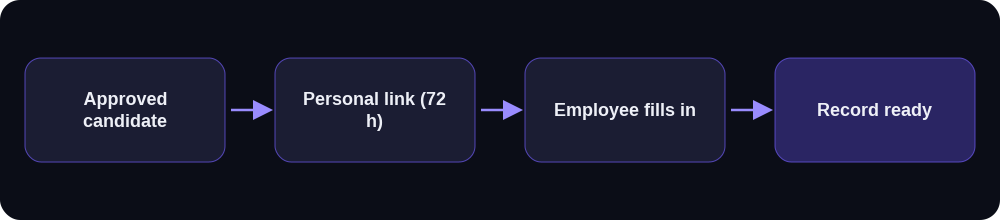
- The candidate moves through the hiring funnel to the approved stage.
- HR only enters the process type, the role and the branch; the system generates a personal link valid for 72 hours.
- The employee opens the link, confirms their identity and fills in their own data.
- The record reaches HR already filled in and the person starts signing in with biometrics.
Where it stands
The digital onboarding module and invitation-based sign-up are in production. The Movement layer, which generates each process checklist with calculated deadlines, and the labor-law rules validator for schedules exist as tested prototypes outside the platform. Payroll calculations stay with accounting, on purpose.
Stack: Next.js, PostgreSQL, Prisma, Python.
What I learned
- The person typing the data is the person most likely to get it wrong. Having the employee fill in their own details removed a large share of rework from HR.
- Deadlines are rules, not artificial intelligence. The Movement layer calculates dates deterministically, and AI only comes in afterwards, for tasks where it adds value.
- Severance calculations are not the system's job: they stay with accounting, on purpose. The system's role is to flag deadlines and organize the process.
Frequently asked questions
Does the system decide hiring or calculate severance?
No. It organizes the process, pre-fills records and tracks deadlines. The decision to hire and payroll calculations remain with people and accounting.
What about the security of employee data?
The link is personal and expires in 72 hours, identification uses tax ID and date of birth, and access supports biometrics. Data handling follows Brazil's privacy law (LGPD).
References
Keep reading

By Junior Carlos de Mattos
I work in marketing and build systems and AI automations. This post describes one of my own projects, in progress. About the author
Want something like this for your business?
Tell me what you need and I'll reply on WhatsApp.
Get in touch